Cluster By, Order By, Sort By: When to use each one in Hive
Publish Date: 2026-07-13 7 min read
Four little clauses in Hive cause more confusion — and more accidental slow queries — than almost anything else in HiveQL: ORDER BY, SORT BY, DISTRIBUTE BY, and CLUSTER BY. On the surface they all sound like they “sort your data.” In reality they do very different things, and picking the wrong one can turn a query that should scale across a hundred machines into one that funnels every row through a single bottleneck.
The good news: once you understand the one idea they’re all built around, choosing between them becomes obvious. Let’s break them down.
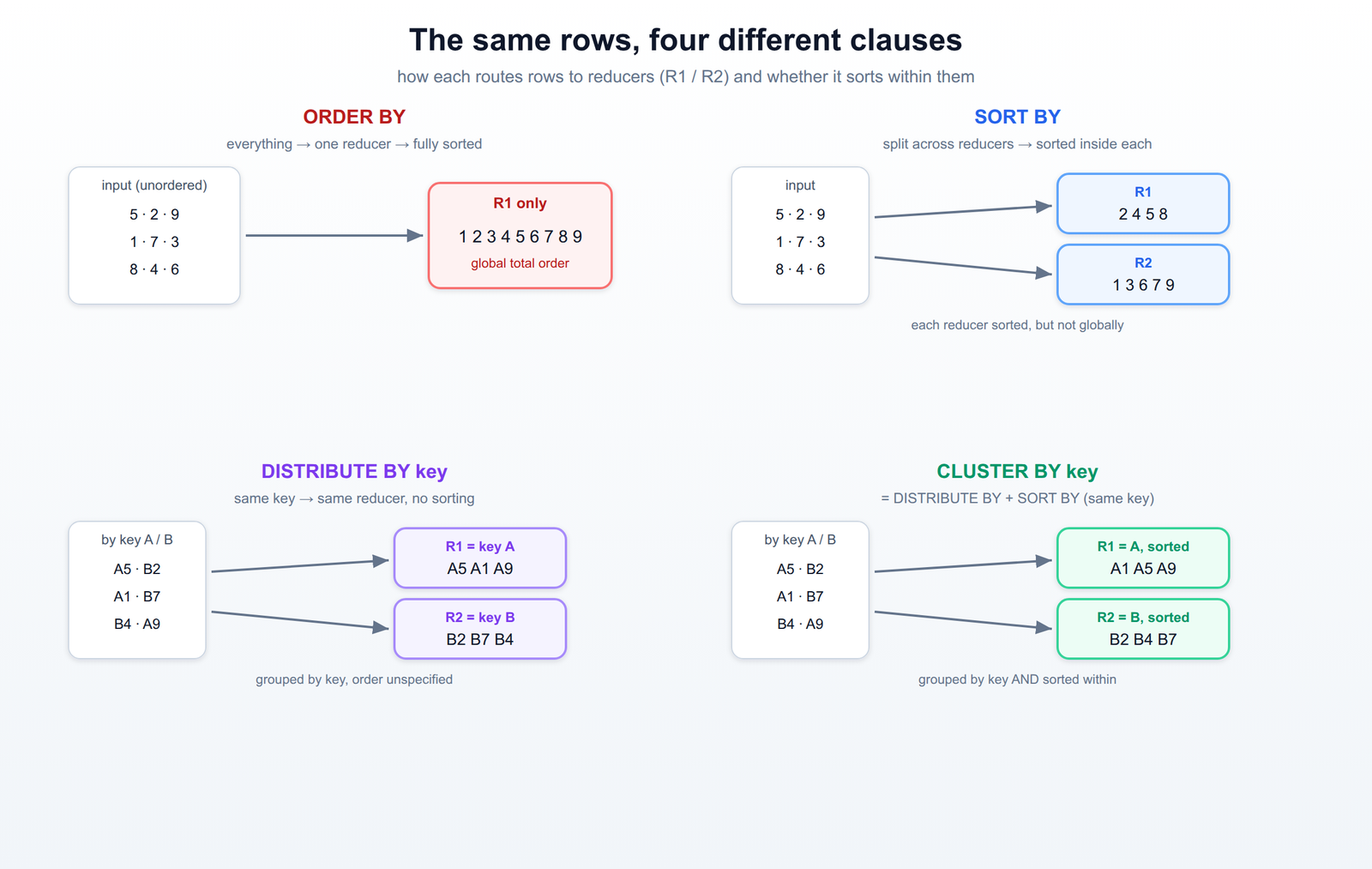
ORDER BY = a single, globally sorted result (one reducer, slow at scale). SORT BY = sorted within each reducer, not globally. DISTRIBUTE BY = controls which reducer a row goes to, with no sorting. CLUSTER BY = DISTRIBUTE BY + SORT BY on the same column. Reach for ORDER BY only when you truly need a total order (and add a LIMIT); use the others for scalable, parallel work.
The one idea: it’s all about reducers
Hive translates your SQL into a distributed job (historically MapReduce, today Tez or Spark). Data is processed in parallel by many reducers, and each reducer only ever sees a slice of the data. Every one of these four clauses is really an instruction about how rows are split across reducers and whether they’re sorted inside each one. Keep that mental model and the rest follows.
ORDER BY — a total, global order
ORDER BY guarantees a complete ordering of all rows in the final output. To do that, Hive has to funnel every row through a single reducer — because no other point in the pipeline sees the whole dataset at once.
SELECT name, salary
FROM   employees
ORDER BY salary DESC;
That single-reducer requirement is exactly why ORDER BY is the clause that quietly kills big queries: sorting a billion rows on one machine is slow and memory-hungry. Hive is so wary of it that in strict mode it refuses to run an ORDER BY without a LIMIT:
-- Safe at scale: sort globally, but only materialize the top rows
SELECT name, salary
FROM   employees
ORDER BY salary DESC
LIMIT  100;
Use it when: you genuinely need one fully sorted result — a top-N leaderboard, a final report — ideally paired with a LIMIT.
SORT BY — ordered within each reducer
SORT BY sorts rows inside each reducer, but makes no promise about the order between reducers. With multiple reducers you get several sorted chunks, not one globally sorted list.
SELECT name, salary
FROM   employees
SORT BY salary DESC;
Because the work is spread across all reducers in parallel, it scales far better than ORDER BY. If you happen to run with a single reducer, SORT BY and ORDER BY produce the same output — but you should never rely on that.
Use it when: you want locally sorted output for downstream processing, or you’re feeding another job that doesn’t need a strict global order.
DISTRIBUTE BY — choosing the reducer
DISTRIBUTE BY controls which reducer a row is sent to: all rows sharing the same DISTRIBUTE BY value land on the same reducer. It does not sort anything — it only groups.
-- Every row for a given department ends up on the same reducer
SELECT name, department, salary
FROM   employees
DISTRIBUTE BY department;
This is the building block for “process all records of the same key together” — the classic prerequisite for per-group logic, custom reducers, or writing one output file per key.
Use it when: you need related rows co-located on the same reducer but don’t care about order — or when you want to pair it with SORT BY.
DISTRIBUTE BY + SORT BY — the flexible combo
Put them together and you get the best of both: group rows by one set of columns, and sort by another. This is the most powerful and common pattern for scalable, ordered-per-group output.
-- Group by department, and within each department sort by salary
SELECT name, department, salary
FROM   employees
DISTRIBUTE BY department
SORT BY     salary DESC;
Crucially, the partition columns and the sort columns can be different — something the shortcut below can’t express.
CLUSTER BY — the shortcut
CLUSTER BY is simply a shorthand for DISTRIBUTE BY x SORT BY x on the same column, ascending. Rows with the same key go to the same reducer, and within each reducer they’re sorted by that key.
-- Equivalent to: DISTRIBUTE BY department SORT BY department
SELECT name, department
FROM   employees
CLUSTER BY department;
The catch: because it forces the distribute and sort columns to be identical, you lose the flexibility of the two-clause form — and it still doesn’t give you a global total order (each reducer is sorted, but the reducers themselves aren’t globally ranked). Use CLUSTER BY when the partition key is the sort key; otherwise reach for DISTRIBUTE BY + SORT BY.
CLUSTER BY (a query clause) with CLUSTERED BY (a table DDL clause). CLUSTERED BY (col) INTO N BUCKETS is bucketing — a physical storage layout that hashes rows into a fixed number of files for faster joins and sampling. Same word, completely different feature.
Quick decision guide
| Clause | Distributes rows? | Sorts rows? | Global order? | Scales? |
|---|---|---|---|---|
ORDER BY | All to 1 reducer | Yes | ✅ Yes | ❌ Poorly (single reducer) |
SORT BY | Hashed across reducers | Within each reducer | ❌ No | ✅ Yes |
DISTRIBUTE BY | By key, across reducers | No | ❌ No | ✅ Yes |
CLUSTER BY | By key, across reducers | Within each reducer | ❌ No | ✅ Yes |
Does this still matter in 2026?
Absolutely — but it’s worth knowing how the ground has shifted. Modern Hive (the Apache Hive 4.x line) has moved on from MapReduce to run on Apache Tez, and it now offers first-class support for Apache Iceberg tables, positioning it firmly inside the modern lakehouse rather than the old Hadoop stack. Recent releases add niceties like built-in auto-compaction and REST-catalog support.
What hasn’t changed is the semantics: the engine still shuffles and reduces data in parallel, so the distinction between a global sort (ORDER BY) and parallel, per-partition work (SORT BY / DISTRIBUTE BY) is as relevant as ever — and the exact same concepts carry straight over to Spark SQL, which uses the identical four keywords. A few modern habits worth adopting:
- Treat
ORDER BYas a “final step, small result” tool. Never use it to sort a huge intermediate dataset; useDISTRIBUTE BY+SORT BYfor that and let the cluster parallelize. - Let the table format do the pruning. On Iceberg (or partitioned/bucketed tables), good partitioning and sort-order metadata mean the engine skips data before it ever sorts — often the biggest win.
- Prefer bucketing (
CLUSTERED BYin DDL) for repeated big joins on the same key, rather than re-shuffling withDISTRIBUTE BYon every query.
Conclusion
Strip away the similar-sounding names and the rule is simple: ORDER BY is the only one that gives a true global sort — and it pays for that with a single-reducer bottleneck, so keep it small and add a LIMIT. Everything else (SORT BY, DISTRIBUTE BY, and their CLUSTER BY shorthand) is about doing ordered, grouped work in parallel. Match the clause to whether you need a global order or scalable per-partition processing, and these four stop being a source of confusion and become four precise tools.
Working with Hive, Spark, or a lakehouse and want a second pair of eyes on performance? Feel free to get in touch.
References & further reading
- Apache Hive — LanguageManual: Sort/Order/Cluster/Distribute By
- Apache Hive — Documentation (latest)
- The Apache Software Foundation — Announcing Apache Hive 4.0
- Apache Iceberg — Hive integration
0 Comments
No comments yet. Be the first to share your thoughts!